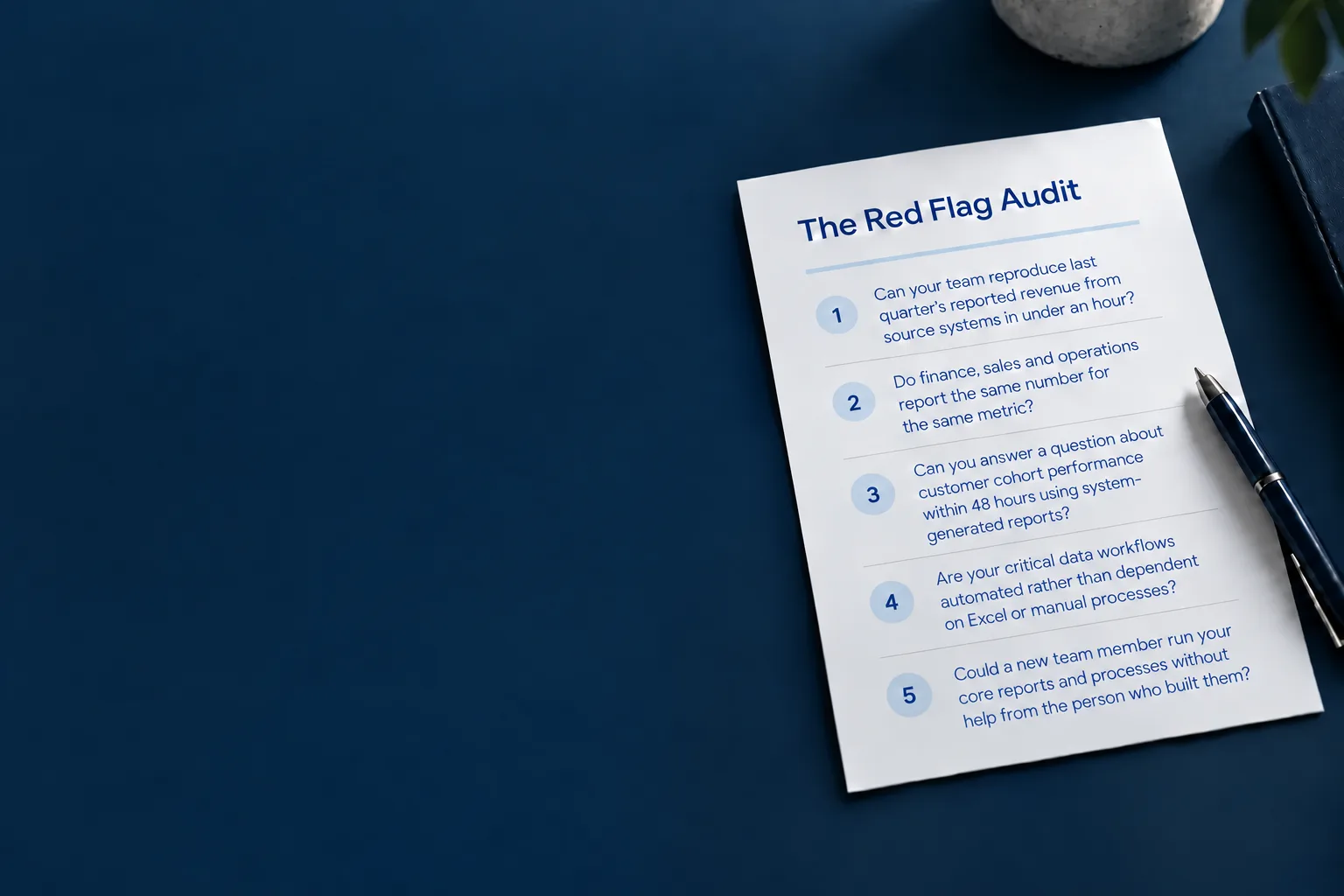
The Red Flag Audit, its five questions printed on one sheet, on a navy desk beside a pen
Illustrative

Would your numbers survive a buyer?
Five questions, two minutes, your score.

Week one of diligence. The buyer's analyst asks for last quarter's revenue from the source system, and the room goes quiet. These five questions tell you now whether yours would. Your score, and what each NO costs.

Score my numbers

Two minutes. No email to see your score.

One client's monthly close went from 30 days to 30 minutes.

A digital media operator. The finance team's close before the work, and after it.
The Red Flag Audit

Buyers don't take your word for it. They test.

Answer the way your team would on a Tuesday, not the way the board deck would. The score is counted on this page.

1. Can your team reproduce last quarter's reported revenue from source systems in under an hour?

Your score and your first flag come up on the next screen. No email to see them.

What each NO costs

A NO is not a gap in a checklist. It is a number a buyer takes off.

The five questions, what a YES looks like, and the discount a NO tends to carry. These are the ranges we see in diligence. Your number depends on your EBITDA and your buyer.

The Red Flag Audit sheet, its five questions numbered one to five
The questionYES looks likeA NO costs
1
Reproduce last quarter's revenue from source systems in under an hour
An automated pipeline from source to report. One query, and the number matches what the board saw.
0.25x to 0.5x off the multipleOn a $10M EBITDA business, $2.5M to $5M. Buyers ask for this in week one. If finance rebuilds it in Excel, they assume the number is soft and question every metric after it.
2
Finance, sales and operations report the same number for the same metric
One definition per metric, one system of record. Every team gives the same answer from the same source.
Two to four weeks added to diligenceThe CFO says 2,400 customers and the CRM says 3,100. The buyer believes the lower one and wonders what else does not reconcile. Every extra week adds deal risk.
3
A cohort question answered within 48 hours from system reports
Cohort retention, revenue by acquisition channel and lifetime value by segment come from systems, not from people rebuilding analysis.
A weaker growth storyCohort analysis is how a buyer validates the growth story. When the answer is that it would be a project, they cannot model forward from your data, so they model conservatively.
4
Critical workflows automated, not dependent on Excel or manual steps
Reporting, pipelines and reconciliation run on scheduled, version-controlled automation. Excel is for ad hoc analysis.
$500K to $2M off the priceIntegration cost goes into the deal model and comes off what they pay. So does the risk that the person who knows how the spreadsheet works leaves after close.
5
A new team member could run core reports without the person who built them
Documented processes, runbooks, and more than one person who understands each critical system.
Earnouts and retention termsWhen Sarah knows how that works is the answer to several questions, the buyer protects themselves by making your exit conditional on people staying.

From the Red Flag Audit, written by Graeme Crawford for PE-backed companies whose numbers have to hold up to a buyer, a board or a sponsor. One assessment this summer, a PE-backed equipment leasing company with every KPI green, found 56 data sources behind one revenue number and 5 of 53 handoffs running system to system.

Graeme Crawford, Founder and CEO of Crawford McMillan
Who is asking

Graeme Crawford

Founder and CEO, Crawford McMillan

Twenty years of data leadership in Fortune 100 and regulated industries, now focused on mid-market PE-backed companies. More than ten data assessments run, for PE-backed companies and owner-led businesses alike. These five questions are the ones a buyer's diligence team asks in week one, and the ones that reprice companies when the answer is no.

He hosts the PE Data Guy podcast and writes Inside The Data Room, the weekly memo for operators who know that the data is the deal.

“Crawford McMillan has provided fantastic support to the New York Public Library on a multi-phase data transformation program, delivering a data maturity assessment, and strong and clear guidance on strategy, data governance, and implementation while preserving NYPL's foundational commitments to privacy, governance, and public trust.”

Jennifer López, Chief Digital Officer, The New York Public Library. Published with NYPL's permission.
What happens next

Your score first. The rest only if you ask.

1

Your score and your first flag

On the screen the moment you answer the fifth question. Which of the five you failed, and which one a buyer would find first.

2

The full read, by email

If you want it, you give an email on the result page. The full read arrives the same working day, from Graeme.

3

Twenty-five minutes, if you failed two or more

A conversation with Graeme on the flags you failed and what it would take to fix them. Free. You book it yourself.

4

Nobody calls you

No call unless you book one. No list sold. The answers are yours to keep either way.

Questions answered

Before you start

Do I have to give an email?

No. Your score and your first flag are on the screen before any email is asked for. The email is for the full read, and only if you want it.

Who sees my answers?

Nobody. The score is worked out on the page, and nothing is stored by us until you ask for the full read. Unless you ask, the answers stay on your screen.

Is this a sales call in disguise?

There is no call unless you book one. If you fail two or more questions, the result page offers twenty-five minutes with Graeme on the flags you failed. If the Investor-Grade Data Assessment fits, he will say so and say what it costs. If it does not, he will say that too.

What is in the full read?

The five questions with what a YES looks like, what each NO costs, and the first thing to fix for each one. It arrives by email the same working day, from Graeme.

Two minutes

Your score, before a buyer asks for it.

These five get asked in the first week of diligence, before the price is final. The discount is set then, from what your team can pull in an hour, not from the board pack.

Score my numbers

Two minutes. No email to see your score.